Start with what brought the client in.
Describe why the client is seeking treatment, with specific symptoms and examples of how daily functioning is affected.
 Write it RightClinical Documentation Trainingby Therapist Resources
Get the course · $37
Write it RightClinical Documentation Trainingby Therapist Resources
Get the course · $37
Course 1 · Diagnostic Assessment
Work through a diagnostic assessment from the presenting problem to treatment recommendations. Learn how to explain your findings and the reasons for your clinical decisions.
$37Self-paced course · lifetime access · 30-day guarantee
Is this a good fit?
Therapists who write diagnostic assessments and want more guidance on what to include and how to explain their findings.
Study at your own pace in Mini Course Generator. Download the PDFs from Google Drive to use alongside the lessons.
An assessment example
Scroll through this shortened example to see how assessment findings inform the diagnosis and treatment recommendations.
Describe why the client is seeking treatment, with specific symptoms and examples of how daily functioning is affected.
Organize the client's history by domain. Use the formulation section to explain how that history relates to the current presentation.
The 11-domain MSE and risk findings make the clinical picture more complete. The course also separates routine monitoring from active reassessment.
Explain the diagnosis and relevant differentials. Consider how strengths and protective factors may support treatment, and how motivation or barriers may affect progress.
Explain the recommended treatment and level of care. Include coordination needs and prognosis, with discharge planning begun at intake.
The symptoms and functional impairment documented at intake help you select treatment goals and establish a baseline for measuring progress.
The review test
Use these questions to review whether your assessment explains the diagnosis and your recommendations.
Symptoms and functional impairment establish the need for care.
The formulation connects reported history, observation, diagnostic criteria, and differentials.
Treatment recommendations and medical necessity make the rationale explicit.
Use the assessment findings and baseline measures when choosing goals. Consider the client's strengths and barriers when planning treatment.
Inside the course
You'll study worked examples and practice writing each section. Later lessons use the findings from earlier parts of the assessment.
Record identifying and referral information, then describe the clinical concern in enough detail to guide the assessment.
Organize the relevant history domains while keeping formulation and recommendations in their proper place.
Use the 11-domain structure to document clinical observations and assessed mental status.
Document current and historical risk alongside protective factors. Use monitoring language that matches the clinical situation.
Explain how the symptoms and impairment support the diagnosis, including relevant differentials. Consider strengths and motivation alongside barriers to treatment.
Explain your treatment recommendations and the rationale for care. Address coordination needs and discharge planning, with a prognosis supported by your findings.
Cover the ten elements the course uses for telehealth records, including modality and place-of-service details.
Apply the framework to multiple diagnoses, re-evaluation, high-risk situations, and adolescent assessment.
A look at the actual workbook
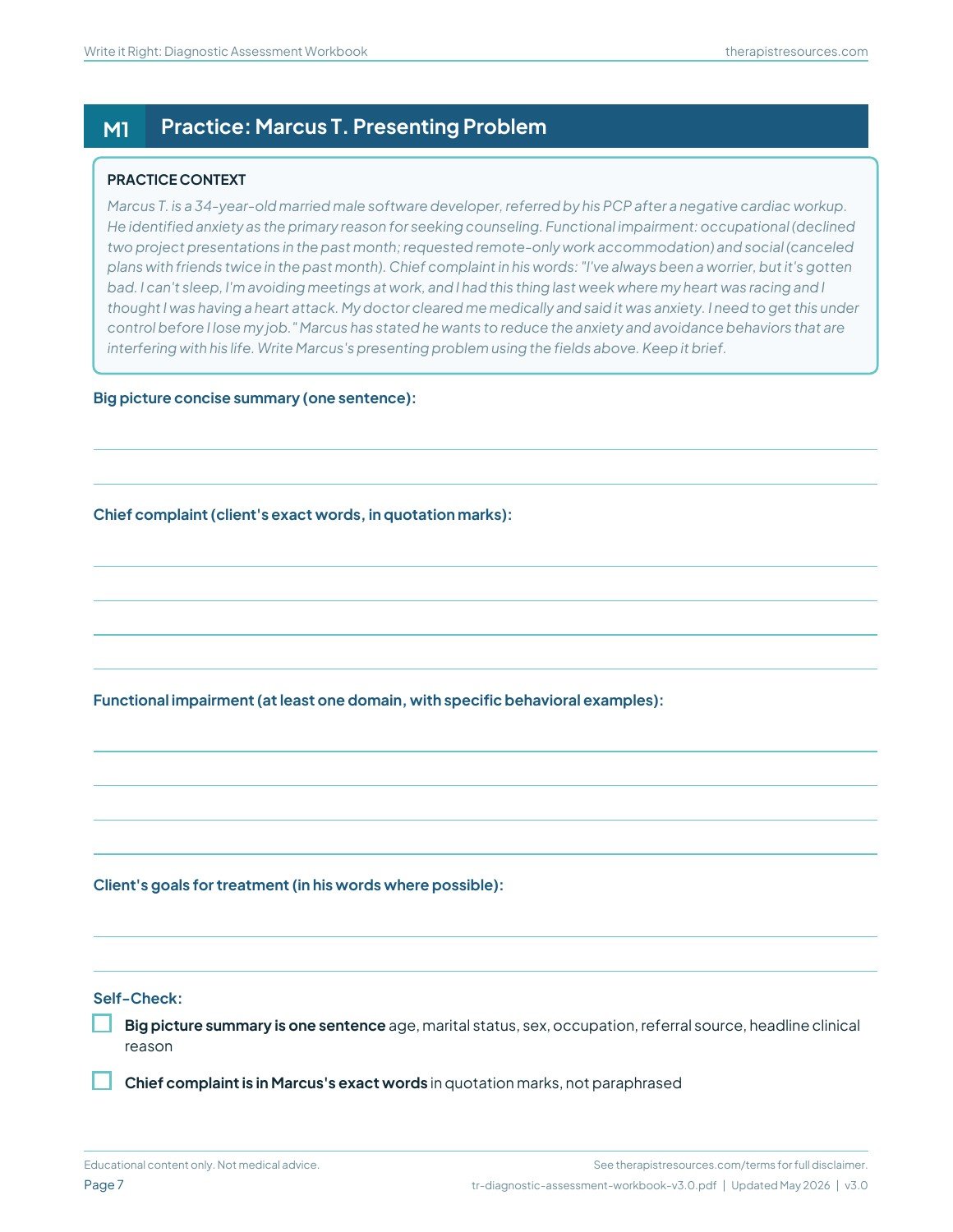
These are pages from the Diagnostic Assessment Workbook PDF included with this course. Select a page to take a closer look.
Work with it
Use the completed examples to compare your responses, then review your assessment with the audit checklist.
Complex presentations
The bonus material addresses more complex presentations and changes in risk. It also includes an example of adolescent assessment.
Organize concurrent symptoms and differentials without losing the primary clinical argument.
Document changes in presentation and explain how current risk findings affect your recommendations.
Apply the framework to developmentally specific history and presentation.
Choose what fits
Choose this course if you'd like help with intake documentation. The bundle also includes Treatment Plans, SOAP Notes, and Case Consults, Summaries & Discharges.
Write it Right: Diagnostic Assessment
Work through the examples and compare them with your own assessment. Which section do you feel least certain about writing?