Explain why treatment is needed.
Document the findings that support your diagnosis and treatment recommendations, including functional impairment and baseline measures.
 Write it RightClinical Documentation Trainingby Therapist Resources
Get the bundle · $97
Write it RightClinical Documentation Trainingby Therapist Resources
Get the bundle · $97
The complete Write it Right series
Renee Devine, MS, LMHC and I created these four courses to explain what to document throughout treatment. The bundle includes the complete Templates and Examples pack.
$97Four courses · templates and examples included · 30-day guarantee
Is this a good fit?
Therapists who want guidance across the full clinical record, from the first assessment to discharge.
Study at your own pace in Mini Course Generator. Download the PDFs from Google Drive to use alongside the lessons.
One client across four courses
Follow the documentation for one fictional client from assessment through discharge. Each course explains what to include and how it relates to earlier clinical findings.
Document the findings that support your diagnosis and treatment recommendations, including functional impairment and baseline measures.
Goals, observable objectives, modality-based interventions, and discharge criteria say how treatment will respond.
Record the session in S/O/I/A/P order, including the interventions you delivered and your assessment of the client's response.
Use consult and contact notes for communication outside sessions. Summaries describe the course of treatment, and the discharge summary records its conclusion.
F41.1 Generalized Anxiety Disorder, Moderate. Baseline GAD-7: 16.
Measurable goal, observable objectives, interventions, and target below 9.
Interventions delivered and the client's response. Session 8 GAD-7: 12.
Reason, course of care, final outcome 4, risk, and aftercare.
The review test
Compare the treatment goals with the assessment findings. Then check how you documented progress and outcome in relation to those goals.
Document the diagnosis and functional impairment, with your rationale for treatment.
Specify measurable treatment goals, with objectives and interventions that address them.
Document the interventions delivered and the client's response. Explain progress or barriers and why continued care is indicated.
Explain the treatment outcome and reason for discharge, including risk findings and aftercare.
Four complete courses
Take the series from intake forward for the full picture, or return to the course that matches the document in front of you.
Work through the presenting problem and history, then the MSE and risk assessment. Develop the formulation and diagnosis, with medical necessity and prognosis. Includes telehealth and complex presentations.
Write measurable goals with observable objectives and modality-based interventions. Review the connections within the plan and practice revisions for more complex situations.
Work through S/O/I/A/P and administrative requirements. Study medical necessity across examples from different sessions, including more complex documentation.
Learn to write consult and contact notes, then treatment and discharge summaries. Includes difficult closures and a three-document capstone.
Compare Marcus's assessment findings with his treatment goals. Follow his progress through the session notes and discharge summary.
Draft your responses using the format guides and practice cases. Compare them with model responses, then use the self-review tools to check your work.
The actual workbooks
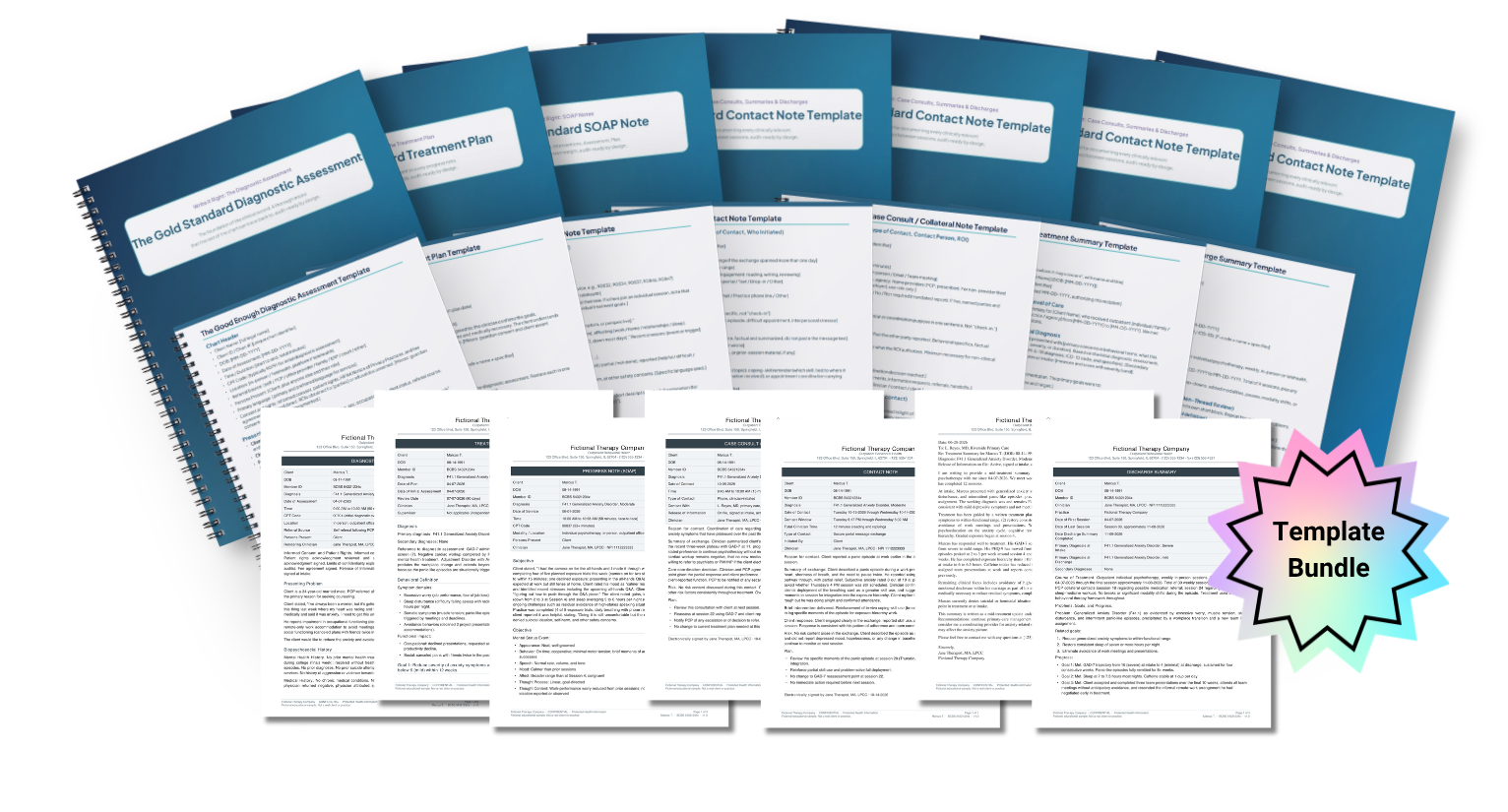
Use the PDFs while you study, then refer back to them when you need an example. Choose a course below to see an inside page and its handout list.
The bundle includes the online courses and downloadable materials. No printed books are shipped.
Included in the bundle
The complete $47 Templates and Examples pack is part of the bundle. Bundle buyers do not need to purchase it separately.
 View larger
Gold Standard and Good Enough structures for the documents across the record.
Compare a filled document with the teaching and the template beside it.
Use the prompts to practice documenting clinical decisions and review your responses.
Use practical self-review tools at the course and series level.
Two ways to use the series
Study the examples to review your own documentation, or use the course concepts to guide documentation feedback in supervision.
Learn what to include in each document and how to check your own work.
Use the examples and self-audit questions to discuss specific documentation decisions.
Use the course topics to identify documentation skills to address during onboarding and supervision.
The people behind Write it Right
Renee and I developed Write it Right to help therapists understand what to document and the reasoning behind it.

MA, LPCC · Co-creator
Rindie is a licensed professional clinical counselor and the founder of Therapist Resources. Her work includes private practice and supervision of early-career clinicians.

MS, LMHC · Co-creator
Renee is a licensed mental health counselor in private practice in Indiana. She brings experience with clinical documentation and audit review to the series.
Choose what fits
Start with an individual course if you want help with a particular document. The templates-only pack is available if you want reference documents without taking a course.
All four courses, templates, completed examples, workbooks, interactive lessons, and self-review tools.
Choose the assessment, treatment-plan, SOAP, or closure course on its own.
The seven document types at two levels, without the courses.
Six short lessons for understanding how the four document types connect.
Write it Right: From Intake to Discharge
Work through the four courses and use the examples to review your own records. Where are you least certain about what to include?